Friday, April 20, 2012

Conceptual Innovation on Communication


“How is social order possible?”

This is the fundamental question of 2nd class of the Social Systems Theory course. Each class has a “Mission Driven” learning style: Before the class, students are assigned to read a quit a lot on books related to the topic of the next class. In the beginning of the class, Prof. Iba exposes the key question to the students. Then, students have a dialogue discussing about the key questions. Finally, they come back to the fundamental question.


“What is the Double Contingency?”
“What does Luhmann suggest in order to overcome the situation of double contingency? ”
These are the first mission to the students to think.
During the dialogue session, we could hear the following thoughts from the students according to the lecture.


"Each actor cannot make decision without any shared norms or culture because it depends on the other’s decision. Therefore, as the core concept of Social Systems Theory, Luhmann emphasizes that perception of little movement of others help them to expect the other’s decision.”


Then, Prof. Iba introduces “Communication” as the synthesis of three selections: information, utterance, and understanding.


Finally, in order to share their understandings on communication Luhmann proposes, students had time for discussing his definition of “communication” and its advantages.


The students will reflect on what they learnt from the lecture and in-class dialogues, and prepare for the next class by reading assignments at home.

Thursday, April 19, 2012

The Rainbow After a Brainstorm (Collaboration Patterns Project #1)

"Collaboration is the secret to breakthrough creativity"
Keith Sawyer, author of Group Genius, concludes in the first paragraph of his book. Collaboration is the theme at the Iba Lab this year. With fifteen members, over half of them being newcomers, the lab was hyped up to create their new pattern language: The Collaboration Patterns.  

Still not getting used to the weird nicknames they were given, members who arrived at the lab Monday afternoon were each handed out a black marker and a rainbow of post-it notes. Despite the cherry blossoms hinting the arrival of spring, the day heading towards dusk was brisk. The original plan to brainstorm outside by the pond had been postponed for next time. 

In the brainstorming process, members jot down attributes they think are important for successful collaboration, talk about it briefly, then sticks the note onto the paper on the table. Their goal: to use up the whole stack before dinner. 

The fifteen sat around a rectangular table, with a huge sheet of white paper spread across it. They started out by each reintroducing themselves with what types of collaboration they've experienced in the past. From gymnastics to marching band, dancing, fashion, theater, part-time jobs, and previous work at the Iba Lab, their specialities covered a wide range of fields. 

The process itself had a slow start. Not really knowing what to do, the new members hesitated to speak up. To get the process going, old members who created the Presentation Patterns last year started out by pinning down a few: things like "respond quickly", "listen to others closely", or "have pride in your work". The first few were the obvious, but a good place to start. 

Soon everyone got a handle of it. Members found out it was easier if they used specific examples from their past experiences when explaining. Watching the table becoming covered with post-it notes, their progress was visible. Repetitions, add-ons, opposite opinions: all were welcome. Selection and grouping were put off for later; just produce. 

With a brief break in between, the process lasted for roughly three hours. Forcing the last of their knowledge out, their brains were fried by the end. Everyone was ready for a nice dinner. 

With a feeling of accomplishment, the members look back at the paper now full of reds, yellows, blues, and greens, somewhat scared of the K-J method to await them.

Next week, the lab members will go through another process of brainstorming. Their next theme is about creation and work environments for groups. 

Sunday, April 15, 2012

What are Creative Systems?


I proposed a new theory for creativity, which I call "Creative Systems Theory," two years ago. In the theory, creative systems are defined as autopoietic systems whose elements are discoveries, and a discovery emerges from the synthesis of the three-part selection: "idea," "association," and "finding."


Creative processes are autopoietic systems that are operationally closed and consequently human and society are considered as factors belonging to its environment. My intention to introduce the concept of autopoiesis is to understand creation itself, separated from psychic and social aspects of creativity. Only this distinction can allow us to consider the relation among creation (creative system), mind (psychic system), and communication (social system).


The details of the creative systems theory is explained in the following paper.

Takashi Iba,  "An Autopoietic Systems Theory for Creativity", Procedia - Social and Behavioral Sciences, Vol.2, Issue 4, 2010, pp.6610-6625
http://www.sciencedirect.com/science/article/pii/S1877042810011298
* You can download the PDF file of this paper.

Abstract
In this paper, a new, non-psychological and non-sociological approach to understanding creativity is proposed. The approach is based on autopoietic system theory, where an autopoietic system is defined as a unity whose organization is defined by a particular network of production processes of elements. While the theory was originally proposed in biology and then applied to sociology, I have applied it to understand the nature of creation, and called it “Creative Systems Theory”. A creative system is an autopoietic system whose element is "discovery," which emerges only when a synthesis of three selections has occurred: "idea," "association," and "finding." With using these concepts, we open the way to understand creation itself separated from psychic and social aspects of creativity. On this basis, the coupling between creative, psychic, and social systems is discussed. I suggest, in this paper, the future of creativity studies, re-defining a discipline "Creatology" for inquiring creative systems and propose an interdisciplinary field as "Creative Sciences" for interdisciplinary connections among creatology, psychology, and so on.

Saturday, April 14, 2012

Cultivate the Social Systems Theory


“What reality can be grasped, when observing our society with the social systems theory? Furthermore, what future will be made based on this understanding?”


This is the fundamental question of the course of Social Systems Theory. The classroom was full with over 150 undergraduate students desiring to creating the world. Even though Prof. Takashi Iba has been teaching this course for over 5 years, this year is quite different from other years.

Until last year, the main focus was that students understand Social Systems Theory, proposed by Niklas Luhmann. However, this year, Prof Takashi Iba embraces the three main objectives of this course.

1. Studying a sociological theory, Social Systems Theory, proposed by Niklas Luhmann
2. Understanding what’s happening in the information society
3. Learning about the media for social change

If he teaches only one of them, the class can be replaced in other colleges. How he creates his own originality is that he combines three of them. In addition, he takes advantages of having this course at SFC (Keio Shonan Fujisawa Campus). Studies are including Biology, Economics, Governance, Linguistics, Sociology, Computer Science, and so on. Since our campus is unique in terms of a variety of students from different academic background, this course helps students studying many different fields to understand the society and come up with their own visions toward the social change.


Here is the contents of this semester.
#1 Introduction
#2 Emergence of Communication as an Event
#3 Media and Code for Communication
#4 Modern Society
#5 Autopoiesis and Structural Coupling
#6 Voice and Exit for Social Change
#7 Scenario Planning: Learning by Making Stories of Future
#8 Pattern Language, part I: Media for User Participation
#9 Pattern Language, part II: Way of Organizational Change
#10 Creative Collaboration: Value Creation through Communication
#11 Open Collaboration, part I: Collaborative Innovation Networks
#12 Open Collaboration, part II: Open-Source Software Development
#13 Open Collaboration, part III: Wiki and Wikipedia
#14 Exploring Philosophy of Social Change


We really look forward to seeing how the students will react after the course ends.


Friday, April 13, 2012

Introducing "Simulation Design"

In order to understand complex, changing systems, such as life, intelligence, and society, it is necessary to acquire the proper tools or methods. Amongst the variety of techniques, simulation examines the systems’ behavior through their dynamics under fixed relations.

For the spring semester of 2012, Prof. Takashi Iba and Tomoki Furukawazono will be lecturing how to perceive complex systems using simulation, in the course: “Simulation Design” at Keio University SFC. Although this course is for undergraduates, each class is far from a one-way “lecture,” but more of a creative, collaborative, discussion and workshop.

“Simulation” is normally defined as computer simulation, but in this course, we define this simulation in a much more comprehensive manner. This course aims to understand and practice simulation by consideration, methods, and practices.

The first session of each lecture is mainly a discussion of what we read and thought. In the second session, students will learn new skills in order to design their own simulation, such as image processing, illustrating software, etc.

After every lecture there will be updates on this blog, including pictures, concerning discussions, exercises, and projects of students taking this course.

We had our first lecture this past Tuesday, introducing the specific flow of the course this semester. The course will proceed as followed:

#1 Introduction

#2 Constructive Way of Understanding

#3 Generative Processes

#4 Abduction

#5 Metaphor

#6 Paradigm Shift

#7 Historical Construction of the Social

#8 Cartesian Paradigm

#9 Batesonian Holism

#10 Patterns and Learning

#11 Autopoiesis

#12 Generative Structure

#13 Network Science

#14 Reflection

We are very eager to see what awaits us throughout this semester, so stay tuned!

Saturday, September 17, 2011

Experience Mining and Dialogues Workshop @ COINs2011

Last week, my students and I attended to the Third International Conference on Collaborative Innovation Networks (COINs2011) held in Basel, Switzerland.

We held a two-hour workshop entitled "Experience Mining and Dialogues with a Pattern Language for Creative Learning." In that workshop, participants talk about their experience of learning each other with using the Learning Patterns. The Learning Patterns is a pattern language for creative learning, namely the collection of practical knowledge of problem-finding and problem-solving in learning.

The goals of this workshop were as follows: first, understanding what a pattern language is like, especially the Learning Patterns, a pattern language for creative learning. Second, reflecting on, talking about, and (re-) designing your own learning. Third, becoming future facilitators of this type of workshop in their own community.

We had more than twenty participants from diverse fields and different countries. While it was our first time to hold a workshop in such an international setting, we enjoyed the facilitation thanks to the eager participants. Not only participants, but also the place of workshop was so nice, because the place of the workshop was the terrace of the Old University offering a wonderful view of the Rhine.

I'm really happy since participants said they enjoyed the workshop and it was eye-opening for them. Furthermore, we learned several hints from their feedback. I greatly appreciate their joining and I would like to thank my team members.


The Place of Workshop on the Rhine


Introduction Session


Demonstration of Dialogue


Dialogue Session


 Reflection Session


Workshop Organizing Team


The video of our presentation is available at the Livestream coninsconference page. Also, the following is the presentation slides posted into the SlideShare.


Saturday, September 3, 2011

Completed the Learning Patterns Card Game

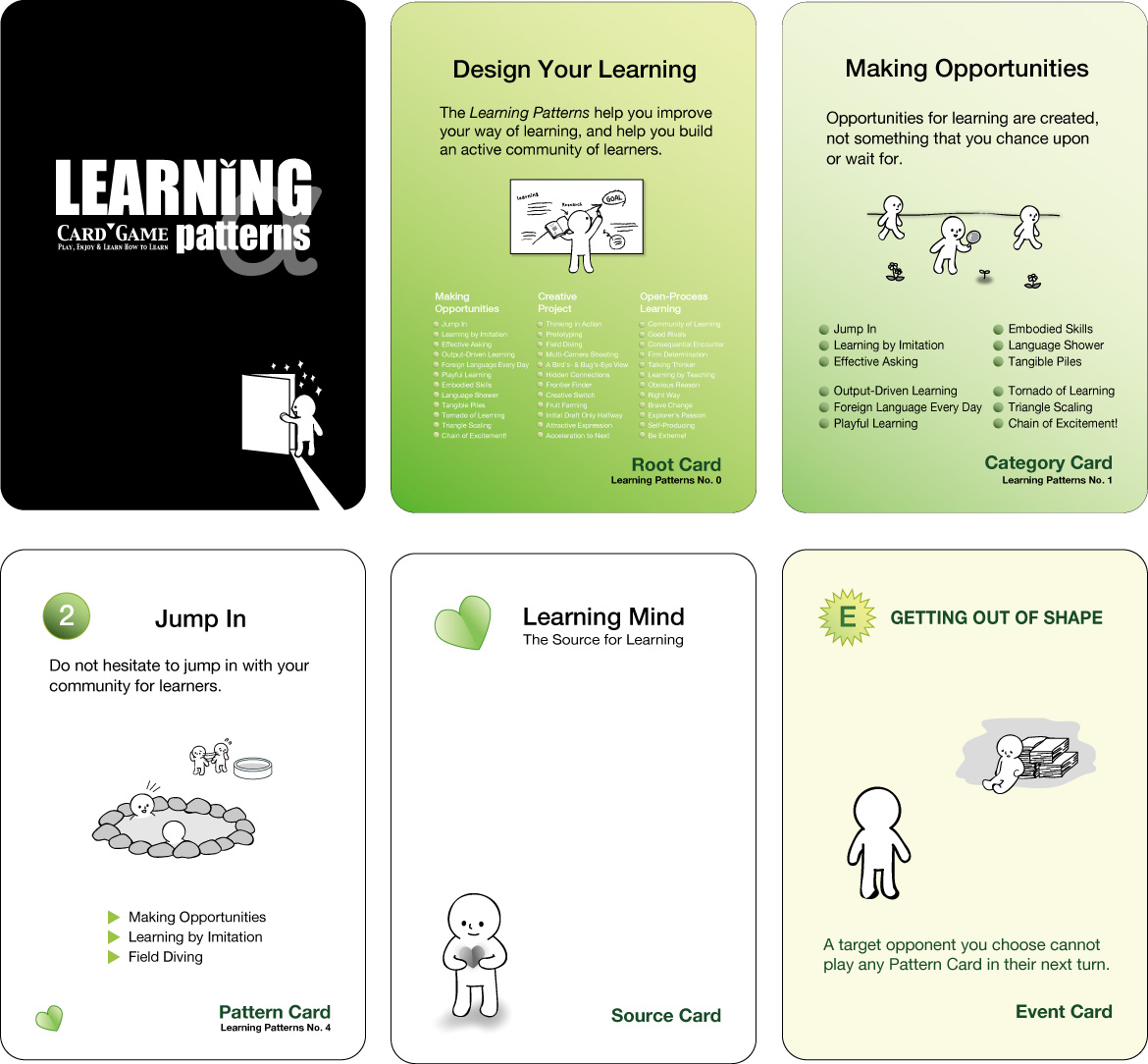
We've just finished making a card game containing the contents of the Learning Patterns, a pattern language for creative learning.

While the Learning Pattern has been originally published in a form of booklet, we now propose a new way to organize and learn them; that is a form of collectable card game, which we name "Learning Patterns Card Game." Our aim of designing this card game is to help learners understand how to learn more enjoyably and also to make opportunities to talk it with others.

We'll present the card game at the upcoming conference, International Conference on Collaborative Innovation Networks (COINs2011) held in Basel, Switzerland, Sep. 8-10, 2011.